Hello guys, I am back with another new article. I know each and every one of you had to work to meet a deadline at some point in your life. And we how stressful it can be. While some of us work well under stress, some of us break down so badly. Today, I am discussing a few tips to help you meet the deadline without stressing out too much.
It is harder for us to concentrate on a task when we bored. Here what we can do is we can spice it up. We need to think of completing the task as a game. And when we finish that task, we should be awarded some rewards.
For example, let’s say you are writing a 1000-word essay for school. Of course, this is going to be boring. So, gamify this task. When you finish the task, you can reward yourself with an hour of your favourite TV series.
Here, having a reward motivates you to complete the task quickly. But make sure that the reward is not too big. If you write the essay and give yourself the freedom to watch a whole season of GOT, you are missing the point. This reason we are using this reward system is to motivate yourself. Enjoy the rewards with awareness.
2. Share your progress
This is the reason why we have project managers for development teams. When you know you have someone who assigns tasks to you and oversee your progress, you are going to be more productive and focused.
If you are a freelancer and you work from home alone, don’t worry I got your back. Here what you can do is to find an accountability partner. Find a friend and make him note down your progress. This is going to make you more productive instantly.
And if you can’t find an accountability partner either, you can post your progress on social media or just use an online tool like Beeminder to make you accountable and make your progress available for everyone to see.
This law talks about the relationship between arousal and performance. Researches show that different types of tasks require different levels of arousal.
In simple words, stress is not all bad. Sometimes we need some stress to get things done more productively.
4. Setting multiple Deadlines
If you think about it, this really does make sense. When you have a big task that takes a few days to complete, you are going to procrastinate in the first few days. Then you are going to try and do everything in one day which makes you fail to meet deadlines.
We can avoid this situation by breaking the tasks down to smaller tasks. So, now when we complete these smaller tasks, we get that sense of achievement. You get the feeling that you are making progress. This makes you complete tasks quickly and increases your productivity significantly.
That is it, guys. Thank you for reading my article. I hope you guys learned something valuable today. If you did, please subscribe and share this article among your friends. Stay safe ✌
Hello guys, this is the beginning of a new article series about Java language fundamentals. I am going to skip the history of Java part and the basic process since it is going to be boring to read for most of you. I am going to start things off by discussing Variables and Operators in Java.
Numerical Variables
Numerical variables can be divided into two sub-sections.
1. Whole Numbers
These are known as integers in maths. I am listing down some examples to make the things clearer.
Number of copies sold of a book
Number of students in a school
Number of birds sitting on a tree
2. Decimal Point Numbers
These are called real numbers in maths. Here are some examples.
Weight of your pizza in grams
Your height in meters
Length of a road in centimeters
How to decide what to choose?
Range of int is from -2,147,483,648 to 2,147,483,647
Range of float is approximately ±3.40282347E+38F (6-7 significant decimal digits)
The common advice is if you are not sure whether to use which data type, go with double data type. This gives you precision up to 15 digits.
What does 34.56f mean?
Here the f means that it is a float number. If you remove the f, you will get a double.
Rules for Declaring Variables
All of these are not rules. Some of these are best practices. So, I recommend you guys to follow these rules when naming a variable in Java.
Must start with a letter (A-Z, a-z)
Can contain Underscore (‘_’) and Dollar Sign (‘$’)
We use equals (“=”) mark to assign values to variables.
Correct ways to declare and initialize variables in Java
int a, b, c;
int a = 10, b, c = 15;
int a = b = c = 10;
Arithmetic Operators
Multiplication (*)
Division (/)
Modulus (%)
Addition (+)
Substraction (-)
Increment (++)
Decrement (–)
Relational Operators
Equals to (==)
Not equals to (!=)
Greater than (>)
Less than (<)
Greater than or equal to (>=)
Less than or equal to (<=)
Logical Operators
Logical AND / Short Circuit AND (&&)
Logical OR / Short Circuit OR (||)
Logical NOT (!)
Type Conversions
This concept is simple. But most students make this harder than it is. There are only 3 points that you guys should remember. Forget all fancy names. Just remember these points.
1. A data type like int can be converted into float without any additional programming. No data loss is going to happen.
int small = 45;
long big = small; //No Data Loss
2. float values can be converted into int using a cast. But here we are going to have a data loss.
float big = 3.98f
int small = (int) big; //small = 3
3. When an operator handles a mix of int and float values, any integers are temporarily converted into float for calculation purposes.
This ends my first Java Fundamental article. I hope you guys understood what I discussed. I always try to be short and clear in my article to make it easier for you guys. If you liked the article, please share it among your friends. And don’t forget to push the subscribe button to receive a notification when I publish a new article. Stay safe ✌
Hello techies, I am here with another article about something that most of you guys might want to know about. If you ever have installed a game on your pc by yourself, you know that we need something called DirectX as a requirement. Have you ever wondered what that is?
Well, I did the work for you guys. Today I am going to talk about DirectX. If it sounds interesting let’s hop in.
DirectX is the multimedia development library created by Microsoft for windows-based applications. It is a collection of APIs (Application Programming Interfaces) created for handling tasks especially related to Game programming and video.
All the names of these APIs started with the word Direct. For example, DirectDraw, Direct3D, and so forth. The name DirectX came up as a shorthand term for all the APIs.
Did You Know?
The letter x in xbox was also added to indicate that the console was based on directX technology
Why it all started?
Microsoft Windows is one of the most popular operating systems. So, even though most of the people in the world shared the same operating system, the hardware was different from one another. And the hardware vendors did not have a reliable standard that Microsoft could develop against.
So, DirectX started as a way to make their products while providing support for all available hardware devices.
DirectX is trying to bridge the gap by providing a standard software interface. In most cases, DirectX succeeds in making these issues transparent to the developers.
All major hardware vendors currently do supply device drivers for DirectX, which provides a high-performance interface for the hardware.
DirectX Components
DirectX can be divided into two separate packages.
1. DirectX SDK (Software Development Kit)
This package provides most of the multimedia development requirements. The following interfaces are included in this package.
DirectDraw
Direct3D Immediate Mode
DirectSound
DirectMusic
DirectInput
DirectPlay
2. DirectX Media SDK
The package contains multimedia extensions to supplement classes in the DirectX SDK.
DirectX Transform
DirectAnimation
DirectShow
Direct3D Retained Mode
Well, that is it for today. I wanted to give a quick introduction to DirectX in this article. If you guys want me to write more in-depth stuff about DirectX, drop a comment down below.
I hope you guys learned something valuable from the article. If you did, please share this article among your friends. And don’t forget to subscribe to the blog to get notifications when I publish a new article. Stay Safe ✌
This must be one of the most common questions you might have had from a very young age. I researched a bit and found out the difference between the two terms recently. Since these two terms are being used interchangeably, I thought of writing a small article explaining this.
So, today I am going to talk about the difference between ICT and IT.
“C” is the difference
IT stands for Information Technology.
ICT stands for Information and Communication Technology.
IT is about collecting and processing information. This field deals with tools related to collecting, processing information including coding and programming.
When someone says that they work in IT, this could mean a broad variety of fields. This could be network administration, computer science, system analysis and more.
ICT includes everything that IT includes and field with further expansion of scope. The communication parts like Wireless Communication, Analog and Digital Communication, Multimedia Communication, Optical fibre Communication, etc are in the scope of ICT.
I hope you guys understand the difference between ICT and IT now. Thank you for reading the article. Stay safe ✌
Hello guys, I am back with another valuable article as always. Today, I am going to reveal you four tricks that will help you to make any difficult decision in your life.
Decision making is never an easy process and it takes a lot out of you. The tricks that I am about to reveal might help you make those difficult decisions and you would finally be able to sleep tight again.
If that sounds interesting, let’s hop into the content.
This is a new perspective of looking at this and probably you might not have heard this before. From the day of birth, our mind is making decisions all the time even though you don’t know it. If you have read my earlier articles, you know that we are in auto-pilot mode throughout most of our daily routine.
Our mind also is like this. With all its experience from taking decisions over and over again, our mind builds up its way of making decisions. It builds kind of a template in your mind. Something like, “If this happens, I should take this decision”.
Here what I am suggesting to do is that we should break these templates. Unless you are going to see one side of the problem and you might end up making a bad decision because of that. If we can remove those templates from our mind, we will be able to absorb the information, think more freely and then take the decision.
List out all the assumptions you have made about your problem
Take each one of them and write down the opposite of those assumptions
Try and find a way to make use of those assumptions when taking your decisions.
The crucial thing we are trying to achieve here is stepping out of your comfort zone. Your mind always makes the assumptions within your comfort zone. What you should do is flip those assumptions and use the complete opposite to make your decisions.
This way, you are going to be more creative which will make you take a smarter decision.
3. Limit the information you take in
This is a big problem, especially for perfectionists, that is clouding your decision-making ability. We think that the more information we have, the better our decision is going to be. Well, that is correct for a machine. But not for you and me. We are not machines. You have to decide when to stop taking in information.
This is kind of like watching tutorials on youtube to do a task. You can’t watch all the videos on youtube about that specific thing. You have to find a video and say this is it. I am going to focus and watch the video right till the end and then get into the business right away. When you watch a lot of videos, since the information is a lot to absorb, you are going to take much more time to complete a simple task.
So, just absorb some information and make the decision. You don’t need all the information in the world to make the decision.
So, here why we do this is to reduce the effect that comes from your emotions. You may have realized this already. Ever wondered why the friends who give the best relationship advice are single? This is because mainly because they can’t get over their own emotions. They have all the information they need to ask his crush. He just can’t get over that emotional cloud to do it.
So, let’s use this to our advantage. Next time you get to make a difficult decision, think that you are deciding for a friend of yours. This way you could absorb the right information and make the decision quickly without any trouble from our emotions.
That is it for today guys. Thank you for taking the time to read my article. I hope you learned something valuable from it. If you did make sure to subscribe so that you will receive notifications when I publish new articles. And also don’t forget to share the article with your friends. That means a lot to me. Stay safe ✌
Hello coders, I am back with a new article as always. Today, I am going to talk about the types of hackers in the tech world. When we talk about hacking, there are mainly 3 types of hackers that you should know about.
1. White-Hat Hackers
These are the “good guys” or Ethical Hackers. White-Hat hackers work for a company usually as a penetration tester or a security researcher. Their job is to find vulnerabilities in the current system to lower the security risks as much as possible.
This is one of the most demanding jobs in the IT field currently. They specialize in ethical hacking tools, methodologies and techniques.
These are the guys who hack for fun. They have a blended intention. They do not have authority to access the system which makes it illegal. But they do not steal any data or harm any process. They just like to show off the loopholes in the sites, get the attention of the public. They do it for their happiness.
In my opinion, ethical hacking is an interesting field for anyone to pursue. And the other thing is that you are never going to be jobless. As long as we use tech devices and systems, you are safe.
I hope you guys learned something new today. Thank you for reading the article. If you liked it, make sure to subscribe so that you will be notified when I publish a new article again. Stay safe ✌
/mine/dream.html (Only useful along with another URL)
URI vs URL
The difference between these two terms is simple. But lot of people get confused with the two terms and use them incorrectly.
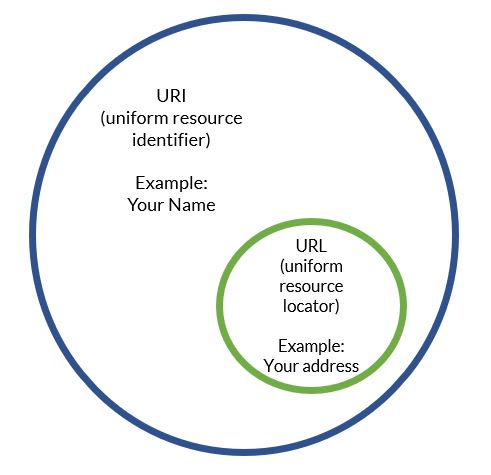
As I said, I can take my Name, Thisura, as a URI. But it does not reveal anything about where I live. If we take my address, that is an example for an URL. If you go to my address, you are going to find me.
URL is a subset of URI. A URL can be taken as a URI. But a URI can not be taken as a URL.
That is it, guys. This was more of a short and simple article. If you want more articles like this, please subscribe to my blog so you will receive notifications when I publish a new post. Thank you for reading the article. Stay safe ✌
Hello guys, I am back with another article. Today, I am going to tell about 5 ancient beliefs that we could adopt for a happier life.
1. Perception is everything
It is believed that there is no such thing as a good or bad event. Events just occur. How you are looking at them is going to make the difference.
So, if you are down all the time and doesn’t feel like nothing is going your way, chances are that you need to change your thought process and the belief system.
For example, let’s say you got fired from your job. If you are going to panic and think that your life is over, you have a problem. How you should be thinking is, “Alright. I got fired. This is not the end of my life. I can always find another job easily. This is a good thing. Now I can focus more on starting that startup I always wanted”. How you look at an event is going to make the difference.
Try be rationalize your thought process. You can easily remove all the garbage from your mind by rationalizing your belief system.
Don’t be overly optimistic like Parker from FRIENDS though 😂
You need to understand that you can’t control everything. Some things are going to happen outside of your control. You can’t do anything about them. You have to accept that and move on. Because worrying about something that is not in your control is just a waste of time.
I am a firm believer in taking responsibility for everything is one of the best ways to improve. But there are times where you just have to accept the fact that you couldn’t have done anything about it. Taking responsibility is great. Just make sure to never waste time worrying about something you couldn’t control.
3. You can learn so much from other people
There are a lot of things that you could learn from the people around you. Here I am talking about mentors or role models. It is always better if you can have a mentor that you could talk to and take advice. I believe that we at least always should have a role model. Someone whom you can loop up to. For example, my role model for the fitness field is Dwayne Johnson.
This is the same thing that David Goggins says about accepting the flaws. The first step to changing yourself is accepting that you suck
For example, you are fat and you want to get fit again. The first step is accepting that you are fat. Most of the guys don’t do this part. Without accepting the fact that you are fat, you are never going to be able to convince your mind to do whatever to change your situation.
It is believed that starting the day with a small meditation session and ending the day by reflecting on what happened throughout the day and what can I do to improve that tomorrow.
That’s it, guys. Thank you for reading my article. I hope you guys enjoyed it. If you liked it please go ahead and share it on social media. And follow the blog to receive notifications when I publish a new article. Stay safe ✌
Hello guys, welcome to another new article from the coding cricketer.
Did you know that there is an ideal time to learn something? These are not superstitions, these are facts backed by Science. These small things might be useful for you one day. Without further ado, let’s hop in.
Making the right decisions at the right time is crucial for a successful life. When you are making these important decisions, you need to make sure that you are not going to regret it. For that, you need to take these important decisions when you are fully alert and focused.
Science says that the best time to take our important decisions is within one to three hours after waking up.
And the worst time to make a decision is just after waking up or just before going to bed. This makes sense because we are not fulling alert in both of these situations.
Brainstorming means to have a group discussion to produce ideas or solve problems.
Researches show that the best time to brainstorm is around 11:00 AM to 3:00 PM. The scientific reason behind this is that this is a time when we are tired and easily distracted. Science says that in this period, our right and left brains communicate with each other which could trigger sparks of brilliance.
3. Best time to Learn Something
We learn until we die. Learning how to learn is an art of its own. We always try to improve our learning experience in some way. Knowing these time slots could be your trump card to get better faster.
Science says that we learn more effectively around 10 am to 2 pm and then again from 4 pm to 10 pm.
And the worst time to learn something is from 4 am to 7 am.
Wait a minute, before you morning people get all worked up. These are research-based facts and these might not be for you. You might be one of the few people who learn best in the morning.
We all are science geeks. All I am saying is to try and experiment a bit, try these time slots for a few weeks, who knows, maybe you might learn even better in these time slots.
This is probably more obvious but still, you might be overseeing this.
Science says that the best time to ask for money from someone is on a Friday evening. People are more likely to be in a happier relaxing mood which would work in your favour.
And the worst time to ask for money from someone is on a Monday morning. On a Monday morning, our mind is stressed out and filled with all sorts of plans and tasks to do. You are more likely to not get the money you ask for.
That is it for today guys. As always, thank you for reading my article. If you learned something valuable, please share the post and subscribe to be notified when I publish an article. Stay Safe ✌
Hello guys, today I am going to talk about a few tips on how to be more productive when working alone. Since most of the people in the world are working from home right now, I think this would be a valuable article who is struggling to be productive.
When you are working at an office and if you get distracted by a co-worker, you may think that you would be able to be more productive if you were working alone at home, right?
Well, it depends. Working at home is not a bed full of roses either. It has its pros and cons. When you are working from home, you don’t have to fight with your own co-worker’s distractions, instead, you have to fight with your mind. When you are at home, you can’t blame on your co-workers for you not being productive. You are responsible for your level of productivity.
This would probably make you realize that the problem is you, not anyone else. So, let’s work on improving your work ethic so that once you are at your office again, you will never get “distracted”.
First of all, you have to try and minimize the chances of you being distracted. I would always recommend adding a pair of noise-cancelling headphones into your workspace if you can afford it. If not, you could plug your earphones in and listen to this Spotify playlist as I do. I can guarantee you that you are going to be 10 times more focused than before.
2. Learn to get into the flow state more often
I’ve talked about the flow state before. I’m sure all of you have this experience. Have you ever lost the track of time when you are focused on some task for an extended period and you can’t be distracted easily? This is what we call the flow state. When we are in the flow state, working becomes much easier and you are going to work for an extended period.
But the hard part is getting into that flow state. Some people can do this easily, but for most of us, it is a real struggle. This is a skill that can be developed over time. Like every other skill, we have to keep practising to get better at it. In this case, the more you practice the shorter the time you take to get into that flow state will be.
And another thing that would drastically improve your flow state time record is meditation. I know you have heard this many times and yes it is worth all the mentions. When you meditate you are training to focus your mind on something for a longer period. This is important to get into that flow state. If you can focus on some task for a longer period, you will automatically get into the flow state.
Watch this video from motivational speaker, Jay Shetty to learn more about the flow state
This makes me remind you of the need of having a clear schedule on how you are going to go through your day. Here what I am especially saying is that it is not only about ticking off your to-do list. You should have a clear idea about the things you shouldn’t do also.
For example, doing your office tasks is not being productive. Being productive is trying and completing your tasks inside office hours and getting off from work. You always need to have clear boundaries. Unless, you may think you are being productive, but you are not.
4. Do it your way
The final and the most important tip for working alone from home is that you need to find your sound. After all, we all are unique from each other. What I am saying might not sound right for you. You may like to do it in some different way. Go ahead and experiment and find the way that works for you.
The best part about working alone from home is being able to do it on our terms. Don’t let me or anyone else tell you how you should work. Find it yourself. Find a fun way for you to enjoy the work and be productive.
Bonus Tip
If you miss the office badly, visit https://imisstheoffice.eu/ . This website simulates a real working environment. You can thank me later.
So, this is it for today guys. Thank you for taking the time to read my article. If you learned something valuable today, please go ahead and share the website among your friends. Stay safe ✌
Time management is a hard thing to master. Most of us tend to waste a lot of our precious time because we don’t plan our days properly. In this article, I am going to talk about a few time management tips you could add to your life to live a productive healthier life.
1. Don’t half-ass it
This is a thing that most of people do without even knowing. One of the reasons is that people believe that they can multitask. No human can multitask and be productive at the same time. You have to compromise one of them.
Let me know if this sounds familiar. So, you join a gym and follow a schedule from an online fitness instructor. You do this for two weeks and realize that you are no getting any muscular. You snap out of it and follows a new schedule. How many times have you changed your fitness schedules like this?
You don’t stick to a plan long enough to see the actual results. One of the common beliefs of successful people is that we should always give it all. Go all in all the time. Have you ever heard about Dwayne Johnson or Arnold Schwarzenegger half-assing a workout? No. Because they give it everything.
When you schedule your day, schedule the hardest task first. If you remember my earlier articles, you know that we all have a limited tank of will power. If you leave harder tasks to be done later of the day, you are going to have a hard time concentrating. You will probably skip the task for tomorrow.
If you schedule your tasks to be done earlier in the day you are more likely to get them done. Besides, you are going to have the motivation to go after simpler tasks.
And if you follow this tip, you are never going to feel like you did nothing today. You will feel more accomplished and more productive.
3. Stick to the schedule
This is an important tip for the perfectionists out there. You have to accept that you are not going to get through your schedule all the time. Some things happen out of our control. You are never going to be able to follow your schedule to the T. The first thing is to accept it.
Now let’s see how we can minimize the damages. So, if your schedule says that you have to run 2 miles, but you started running later than usual, what are you going to do?
If you try to finish the whole 2 miles, you know that you are going to be running behind the schedule the whole day. And probably at the end day, you are going to run out of time so that you would have to skip replying to emails.
So, here what I am suggesting is that reduce the number of miles for today. Run just 1 mile for today. Now you have time. Now you are back on track. Take smart decisions. Always prioritize on doing the task, rather than following the schedule to the T every single day.
That is it for today guys. Thank you for taking the time to read my article. I hope you learned something valuable today. If you like the article please subscribe by putting in your email so that you will be notified when I add a new article. Stay Safe ✌
Hello guys, today I am here with another really important article. The things I am going to talk about might just be the turning point you’ve been looking for. Today, I am going to talk about the reasons why you don’t do the things you know you should be doing. Let’s hop into it.
1. Knowledge and Execution are two things
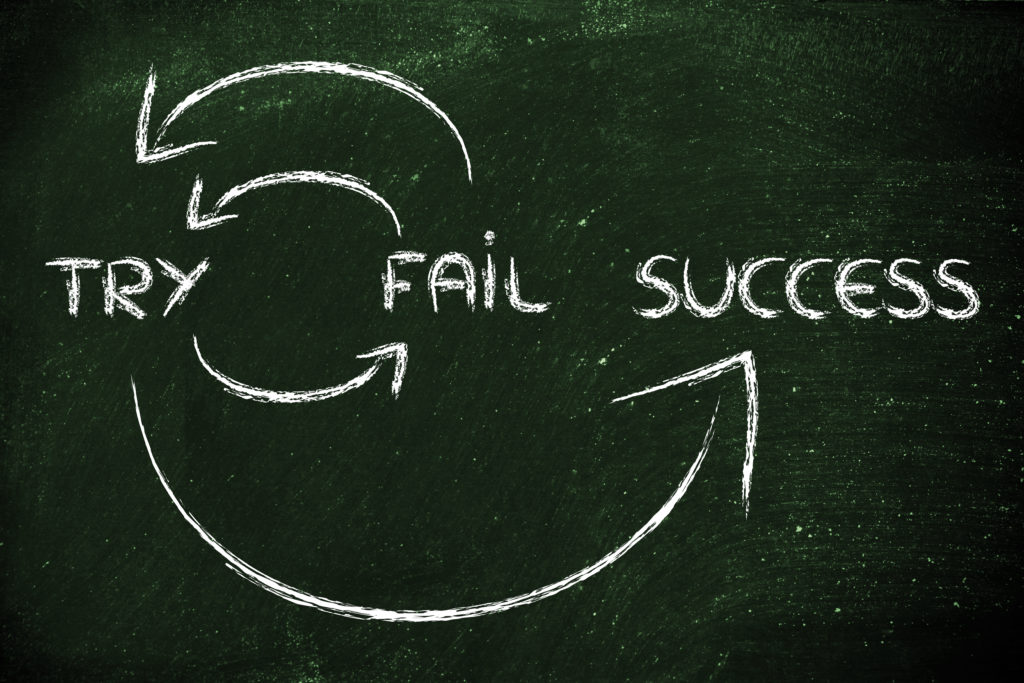
Even if you have all the knowledge in the world about doing something, you are not going to be good at it on your first try. You are going to fail. You are going to mess it up.
Knowing something is easy, but doing it and improving is the hard part. You have to understand this. You are going to need a lot of mental strength to do something consistently.
In my opinion, the best way that you could do something consistently is learning to love the process. If you are fat and you want to exercise and lose some weight, you could put up a big picture of yourself in your room’s wall so that everyone that comes to your room is going to notice that. Make a rule for yourself saying that you can’t remove the picture. The only thing you can do is replacing it. This way, you are going to be motivated to keep improving.
The environment we live in has a bigger impact on your life than you think. This is a universal theory. This is why Jim Rohn once said that you are the average of the five people you spend the most time with, and that means everyone in your life counts.
Same goes for the environment you live in. This is why your mom shouts you to make the bed after you get up. If your room is messy, more often than not your mind is going to be messy too.
If we look at this from another perspective, let’s say you are eating junk food way too much and you want to reduce it. Change the environment. Remove all the junk food from your house. That is it. Simple, right?
This is another big turning point. Your peers could either make you or break you for some extent. If you have peers who encourage you to go to your goals and help you when you are down, the road to success gets much easier.
On the other hand, if your peers always say negative stuff, the things are going to be much harder for you.
You should always try to be in a social group that encourages you to change your life for the better. If you feel like you are not in a one right now, get yourself out of there.
4. Plan Deep
As I always tell you, you should always schedule your day. And also, you should have a clear path on how you are going to achieve your goal. A goal without a clear path is just a dream.
You need to plan deep here. Yes, I understand that things do not go according to plan sometimes. But that doesn’t mean that you shouldn’t have a plan. You should have a clear idea about when to take specific decisions. It could be knowing when to quit your job to start your own business. It could be when to take a certain course. And besides, you should always try to cover all the possibilities.
If this happens I am doing this. If my WordPress site gets more than 10000 views per day, I am going to upgrade to a business plan. It could be whatever you want, you should always have a clear idea about what to do and when to do it.
5. Build good habits
The reason why you have resistance when doing something is that because you don’t have a clear path.
Since most of the things we do in our day-to-day life are habitual, all you have to do is the build-up few good habits and you are halfway there.
Here is a link to the best habit-building course, I’ve seen and it is free. This course is from a youtube channel I admire called Improvement Pill.
The Tamed Course – Video 1
This is the first video in the video series. I encourage you to go ahead and watch the full playlist because this video series really tranformational for me personally.
Well, that’s it for today guys. Good bye. I’ll see you soon with another article. Stay home. Stay safe ✌
Hello guys, I am back with another new article. We live in a fast-moving world. New technologies are being born every day. Yes, I agree that it is hard to be updated about everything. As a person working in the IT industry, I know the struggle.
But we can’t blame it on the world. The world is not going to stop spinning for us. We have to keep up with the world. For that, we need to learn how to learn things faster. Today I am going to teach you just that. Let’s hop in.
This is a critical point that most of the people overlook. You may say that you can process the information in your brain and so you don’t need to talk it out loud. Well, I am not going to doubt you.
The reason I am emphasizing on this point this much is that this is something I use all the time. This does work. This is the same reason why they say to write down the concept you learned like you are explaining it to a 5-year-old. This way, you are going to try to simplify the concept you learned as much as possible which makes you realize the areas you struggle to explain. Most of the times, you will always have a place where you struggle to break it down.
In this case, when you learn a new concept, all you have to do is just explain it to yourself and try to simplify it as much as possible. Try it out once. You will see the difference.
Researches have proved that you are more likely to comprehend and remember the things you write when you are taking notes by hand rather than typing in your laptop. Yes, I know that you can type way more faster than you could ever write. Well, this could be the reason why you are living a mediocre life right now. Everything adds up to the ultimate result. Make small changes.
3. Put your self to the test
You can fool anyone. But you can’t fool yourself. When you learn a new concept, always try to challenge yourself.
For example, if you are a programmer and let’s say you just completed a CSS course. Challenge yourself to create a creative login page for a website. This will be hard for you in the beginning. If you can keep yourself accountable, this method will do wonders for you. You will learn a lot more things that you didn’t learn in the course. Since you are finding everything out on your own and not just following someone else’s instructions, you are more likely to remember the content.
This is a piece of very common advice and yet most of you are going to just skip this one for sure. This has become the mantra of most of the youtube life advisers in today’s world. Well, there are a lot of good reasons for it.
Exercising enhances your mood. It decreases the risk of you getting cancer or Alzheimer’s disease. Exercising builds your confidence for you to go after your goals. Exercising helps you build good social skills. Exercising decrease your stress levels. I could go on and on, but you should get the point by now.
It doesn’t have to be lifting weights. You could do some yoga. You could go hiking, cycling, swimming or just walk for 30 minutes at a brisk pace.
5. Study parallel concepts
When you learn a new concept, one of the best ways to understand it more is to read more about related topics. For example, let’s say you learn about the solar system today. Now you can go ahead and learn about the Milky Way Galaxy, the ISS (International Space Station) or maybe about asteroids and meteors. When you learn more about the related topics, you are going to get a deep understanding of the concept you learned in the first place.
6. Just take a nap
I have mentioned this in an earlier article as well. The researchers have shown that our subconscious mind takes control over when we are asleep. And they have found out that the consolidation process is going to start when we are asleep.
On the other hand, not having enough sleep affects your ability to push your new data into your long-term memory.
Well, that’s it for today guys. I hope you guys learned something valuable from today’s article. Like I always say, try to add at least one of these methods to your lifestyle and feel the difference. Thank you for reading my article. Stay tuned ✌
Hello guys, I am back with another article valuable to anyone who likes to learn something every day.
I think by now you guys should know that I am obsessed with learning something every day and improving myself. And since you chose to read this article, I believe you are just like me. So, today I am going to share some methods that I came across which have been proven scientifically. Let’s hop into it.
1. Just get your head down and go at it
I think most of you will agree with me if I say that starting something is the hardest thing to do. When we do it for some time, we get into a flow state where we hardly get distracted and even lose the track of time.
But how do we just start it in the first place? We need to bring down the friction as much as possible. Let me explain this with an example.
Let me know if you have experienced this. You just watched a transformational video from some guy on youtube and you are so pumped and motivated to start going to the gym the next morning and to change your life for once and for all. You dream about how you have six-packs in a few years and how every girl you pass by checks you out. Then you go to sleep. When you get up in the next morning, the motivation is gone and you say to yourself, “Today doesn’t look like a good day. Maybe I will go tomorrow”.
Sounds familiar? Well, if it does, don’t worry. You are not alone. This is the friction I am talking about. This is the barrier you want to pass. You have to keep passing that barrier day in and day out, when you start something. Well, this takes a lot of will power. As I discussed in this article, we all have a certain amount of will power to consume.
So, how do I bring down the friction level?
This is simple. If you want to go to the gym tomorrow morning, pack your gym bag right now. Wear your gym clothes to bed. Or maybe just get the clothes ready and put them somewhere you will see right away after you get up. Do whatever you could do to force yourself to do it.
2. Learn Chunking
Here what you need to do is think of a concept that you want to learn about. Break down the bigger concepts into smaller units. Try to identify the connections between those small units. Organize and group the information according to those connections and create chunks that you could refer to later.
This is a proven strategy to decrease the cognitive load when you process the information. You already do this in your real life without knowing it. This is why we remember mobile numbers written like “077 123 456 7” rather than like “0771234567”. Try to apply this strategy when learning new things as well.
3. Learn. Recall. Repeat
Just writing down and organizing the things you learn is not enough. You will forget it completely in a week. Your brain is a very active unit. It has lots of balls in the air. It has to make you drink more water if the body needs more. Your brain has more important stuff to do rather than storing some concept you learned yesterday. So, we have to force our brain to do it.
The only way to do this is by recalling the things you learned over and over again for some time. When we do this, our brain thinks, “He is studying this over and over again every day. This must be something important. Let’s save it”.
But just recalling the concept over and over again is not going to do it either. To make sure we save the concept for once and for all, we need to use this concept somewhere. This is proven to be the best way to memorize something.
4. Don’t be too hard on yourself
If you are stuck in a problem for hours and you can’t seem to be making any progress. Just take a break. Drink some water. Go for a walk. Take a nap. Do anything other than thinking about that problem. And when you get back to your problem later, you will start to see the answer from nowhere.
Yes. Sleeping on your problem actually could pave you a way to solve it. The strategy here is that when we sleep or do something for that matter, we are focusing on the thing that we are doing at the moment. But while we are doing that, our subconscious mind is trying to solve that problem you are stuck on. You won’t even feel it. Our subconscious mind is really powerful. I’ll write an article about the power of our subconscious mind and the law of attraction later.
For now, just take it easy. Take a break
5. Schedule your tasks
You may have heard this thousand of times, but you might not know the reason why they say it. There is a law called the Parkinson’s Second Law which is where this strategy originates from. The law states that work expands so as to fill the time available for its completion.
You may have experienced this already if you have tried the Pomodoro technique at least once. When we set a task for our 25 minute time block (or whatever time block you choose), our focus sharpens and we give our everything to complete the task inside the given period. I’ll write a descriptive article about the Pomodoro technique as well in the coming future.
That is it for today. I hope you guys enjoyed reading the article and learned something valuable as I promised. And please don’t just stop here. Adapt at least one of these strategies to your learning process. Believe me, you will feel a big improvement. Have Fun. Enjoy life 🤘
Hello guys, welcome to my new section called “The Knowledge Book”. In this page, I am going to post valuable articles with tips, techniques and habits about making the small differences which would turn out to be quite effective in the long run.
Today, I am going to talk about time management techniques from highly successful people which I think you should add up into your day-to-day life and see the difference for yourself.
1. Make quick decisions when it doesn’t matter
You may have already heard of this before. Mark Zuckerberg, the founder of Facebook, wears his grey coloured t-shirt every single day. Steve Jobs, one of the co-founders of Apple, wore his black turtleneck to every one of his keynote speeches.
Steve Jobs in his black turtleneck while doing a keynote speech
When we wake up, everyone is going to have a tank filled with will power. As the day unravels that will power level is going to drop along with the decisions we take.
So, what these guys are doing is they are saving their will power for more important decisions, for the things that really matter. If you have a big wardrobe with many choices, you are going to waste so much of your energy for something unnecessary.
How can I implement this in my life?
I believe each and every one of you has that one outfit which makes you feel like you are on top of the world when you slip it in. So, empty your wardrobe except for that outfit. Go out there and buy the same outfit as much as you need. Start to wear it every single day.
This way, you feel amazing every day and you save your precious willpower. Two birds in one stone right there.
2. Schedule your day according to your energy levels
Each and every one of us has our own peak time in the day where our energy levels are high and you feel like crushing your to-do-list. For me, it is around 9 to 12 at night. I am trying to be a morning person, but I am not there right now. May be your energy levels are high right after you get up in the morning.
How do I implement this in my life?
Find your peak hours and schedule your day around it. Do your less important stuff for when you have a low energy level. Right after lunch is the time I do my shallow work. Because after lunch, I feel so sleepy, my energy levels go down the hill. So during this time, we should pick our less important tasks like replying to emails, listening to a podcast or whatever it might be for you.
3. Go with the 2-minute rule for Smaller Tasks
This rule simply states that if a task in your to-do-list can be done in 2 minutes, just go ahead and finish it.
This way you can tick off all your small tasks quickly so that you could focus on more important tasks freely.
Read this article to learn more about the 2-minute rule.
How can I implement this in my life?
First of all, go through your to-do list and identify the 2-minute tasks you need to do today. It can be communicating something to your co-worker, writing in your journal, giving someone a compliment, doing 10 pushups or maybe just relaxing and doing mindful meditation. Whatever it might be, if it can be done inside 2 minutes just do it.
4. Try Elon Musk’s Time Boxing Method for Bigger Tasks
So, this is a method used by world-famous successful entrepreneur, Elon Musk. He breaks down his tasks to 5-minute tasks. He then just focuses on that simple task for that 5 minutes and gets it done. Then he moves on to his next task for the next 5 minutes and so on for the whole day.
This is a very powerful method and a proven method because when we finish a task we get that adrenaline rush, the feeling of achievement, the motivation to move on to the next task. This constant motivation we get from being able to cross that one task off our list for every 5 minutes is very useful to get through the day.
I will explain this using one of my personal experiences. As software engineers, a very important skill we have to develop is tracking bugs and fixing them. When we get the details about a bug, first of all, we try and replicate the bug in our local environment. After that, we track the code from head to tail until we find the place that gives the error. Then we do the necessary fixes after that. Even though the process sounds simple it can be a long process especially for a beginner just like me. I learned this the hard way.
So, what I do is I break the tasks down as much as possible into 5-minute tasks and finish them. This way, I can keep a clear mind and focus on the thing we are doing at the moment.
5. Use your Free Time Effectively
We all have free periods in our schedules to relax and have some fun doing whatever we want. Most of us may browse through social media, play some games or watch some Netfilx. But if you really think about it, don’t you feel like you are unable to focus on your work right after your free time? Well, at least most of us do.
I feel this all the time. Right after, playing some PUBG matches in my free time, I try to focus on my code which by the way is an impossible thing to do for me. My mind just wanders all over the place. I know most of you should have had this feeling too.
So, here what you could do is to replace the thing that you do in your free time with something useful.
How can I add this to my routine?
So, instead of mindlessly browsing through social media or playing games, you could try reading a few pages of a book. You could organize your computer’s folder structure. You could plan the next day or how you are going to spend the weekend. You listen to a podcast or an audiobook. You could learn a new language ( Try the Duolingo app). Take a walk. Do some mindful meditation to clear your mind. Learn a new skill.
It should not be something that bores you. Pick something you enjoy and something that would add value to your life in the long run.
So, I hope you guys learned something valuable today. Thank you for taking the time to read the article. I’ll see you tomorrow.
Hello guys, I am back with another article that I think will be super useful for any programmer, especially for someone who is a beginner to the field. Without further ado, let’s get into it.
Nowadays, everyone is talking about writing quality code. Well as programmers, we know from experience that there is no such thing as perfect code. Because your code works properly even after doing 1000 test runs, doesn’t necessarily mean that your code is bug-free. Actually, there is a basic concept in quality assurance saying exactly that.
The best thing you could do is writing a quality flexible easy to understand code solution. Commenting your code properly is a must-have skill you need to have in your skill repertoire in order to write a quality code solution.
In my opinion, basically, there are 3 occasions where you should add comments in your code.
At the beginning of a class
/**
 * Class description goes here
 *
 * @version 1.0 05/04/2020
 * @author firstname lastname
 */
Add a simple document comment like shown in the picture. You can always modify the comment to anything you want. But always try to keep it simple and clear as it will be easier for someone else to understand the purpose of creating the class.
At the beginning of a method
/**
     * Adds two integers and return the total
     *
     * @param num1 - int
     * @param num2 - int
     * @return total - int
     * @author Thisura Thenuka 05/04/2020
     */
    public static int addNumbers(int num1, int num2){
        return num1 + num2;
    }
I added the data type of the parameters to make it more clear for someone who reads it.
To clarify a piece of code
/* Checking if the total is odd or even and logging to the console */
        if (total % 2 == 0) {
            System.out.println("Entered number is even");
        } else {
            System.out.println("Entered number is odd");
        }
You can use comments anywhere to clarify a piece of code. As long as it is brief and clear, you are good to go.
This is just useless. This is just going to ruin the clarity of the code.
Be professional
//What is this? This code sucks. Go and learn the basics first, Drake
Never write comments like this. I have seen this mostly in open source projects. You would feel like you are releasing your frustration. But you are going to look like a fool. Learn to manage your anger and instead write a comment like this.
//The code below is not up to the standard.
//I commented that piece of code and added my own code
Well, that’s it for today guys. Thank you for reading the article. If you learned something valuable, go ahead and subscribe to get an email when I upload a new article. Have a nice day and stay safe ❤✌
Hello guys, I am back after a long break. I think this actually is the first article that you guys might be seeing in the coding section of my website.
Let’s get into today’s article. Today I am going to tell you guys about simple tips to become a better coder.
I myself is a victim of this. Usually when we are working under tight deadlines, we are tempted to just copy and paste a part of code from some website and finish the work faster. But this process can be counter-productive, especially if you are new to the field just like me.
If you don’t completely understand the code, just google the code line by line and try to understand what each line of code really do. Otherwise if you are asked to replicate a function you did in some other project, I guarantee that you won’t be able to do that without referring to the earlier code.
So, what I recommend is that never write a line of code if you don’t understand what it does. Just go and google. I would take 1-2 minutes max and if you are likely to forget it, you could always write it down in your notebook. But believe me it would be super useful to you in the future.
Stack Overflow should be your last option, not the first one
You should never refer to stack overflow, when you come up with a problem. Always refer the documentations of the language you are using first. Always try to be familiar with the documentations. It is going to be your best friend going forward. This is the only way you are going to learn something properly.
Every programmer has his own unique coding style. If you refer to Stack Overflow more often, you are not going to develop your own coding style. Documentations give you the basic knowledge you need. Then you can go build the logic in your own terms.
I am not saying that you should stay away from Stack Overflow. I am just saying it should not be your first option.
When you refer to documentations and try to build your logic in your own code, you are going to come up with errors. That is normal. You might not be able to fix it even by debugging. You might have to go to Stack Overflow and you may find what is wrong with your code there.
So, this moment is crucial brother. You again should never copy and paste the code. Don’t do it even if you understand the whole thing. Write down what went wrong in your notebook and how you fixed it. This way you are more likely to remember how to get over that particular error if you ever come across it someday.
Pick a part of your code or maybe a coding concept
Research about that topic and write down everything you find out in your notebook
Try to explain that part of code or the topic in simpler terms to someone else
Repeat the process until you don’t need to refer to your notebook at all
If you can explain a coding concept or a part of code to someone else, you can say that you understand the code. If you can’t, you just don’t understand the concept properly yet. In that case, you should keep learning about this concept
That is it for today guys. Thanks for reading my article. If you found it useful, subscribe to my blog and share the article among your “coder” friends. Hope to see you guys soon.
Hey guys, it is Thisura here after some time. It feels really good to be writing again.
In today’s article, I am talking about how CAPTCHA work and how its main features work.
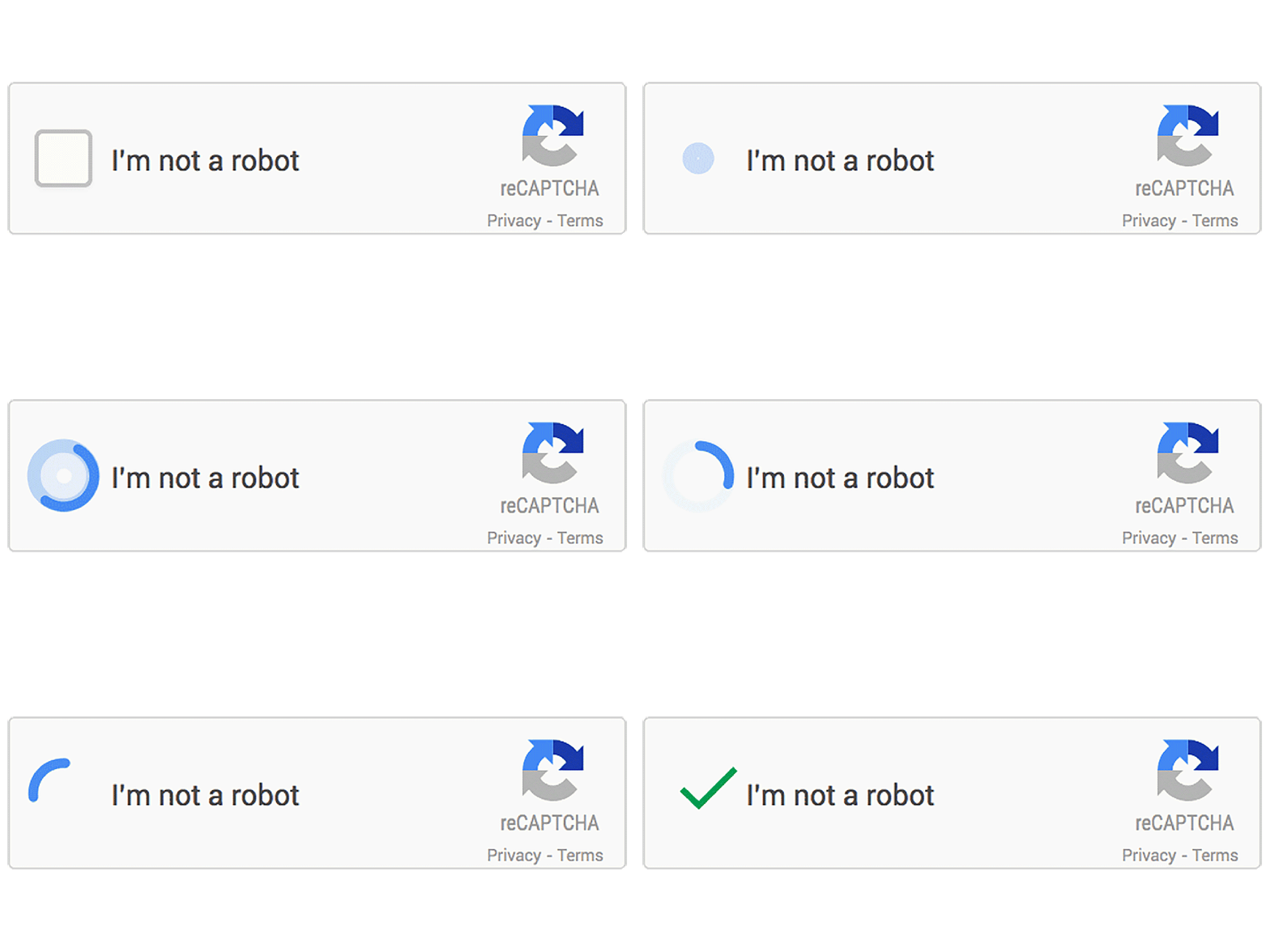
So, when you are signing up for a website or when you try to comment on a blog post, have you ever seen a checkbox that says “I am not a robot” and wondered how the heck it is going to decide whether I am a robot or not? It is impossible, right? How on earth can an automated program decide whether I am a robot or not?
Well, then you can count yourself lucky. Because today I am going to talk about exactly that. That checkbox is a test called CAPTCHA which is what my topic for today’s post. So, let’s hop in, shall we?
So, as I told you that checkbox you saw that day was a Turing test. I hope you know what a Turing test is. If you don’t feel free to check out this 2 min video clip to get an idea. This test was designed to check whether a user is a bot or a real person.
What is CAPTCHA?
The term CAPTCHA stands for Completely Automated Public Turing test to tell Computers and Humans Apart. This test has been proved to be successful in doing its job over the years.
How does CAPTCHA work?
Usually, CAPTCHAs show you a distorted set of alphanumeric characters. You have to type the set of characters in the exact order and prove that you are a real person.
The reason why this test uses a distorted set of characters is so that bots can’t read them. If the user fails to guess the characters correctly, he has to try again and again until he succeeds.
Where can we find them?
You can find these Turing tests in login forms, signup forms, feedback forms or even when you are going to check out something from an e-commerce website.
Why reCAPTCHA then?
Well, the CAPTCHAs did a great job for a long time. But with the evolution of machine learning, people (hackers to be more specific) were able to create advanced bots who could understand those distorted handwritten type of characters. Hence, ordinary CAPTCHA tests had to be replaced with more complex Turing tests. Google developed reCAPTCHA to do just that.
What is reCAPTCHA?
Well, reCAPTCHAs were developed by a set of researchers at Carnegie Mellon University. This technology was later acquired by Google in 2009.
The difference between CAPTCHA and reCAPTCHA
Instead of generating distorted characters, reCAPTCHA uses real-world images to find the bots. reCAPTCHA uses images like street address boards, texts from books and old newspapers, etc.
reCAPTCHA has been developed over the years and has 3 types of tests by now.
They show some kind of a photo (or a set of photos in this case) that contains 9 or 16 squares. User is asked to identify and choose the particular squares that contain a certain object such as an animal, tree or a street sign (in this case, a statue).
This is not about checking the checkbox at all. This is all about the way you click it. reCAPTCHA checks the way your mouse move and predicts whether you are a bot or not.
In addition to that, this type of reCAPTCHAs check for your device history and cookies in the browser to confirm its decisions.
No Interaction type
This test is invisible. There is nothing for you to interact with here. This test is based on the way you behave on the internet. For example, if it recognizes that the user is clicking on links at an abnormal rate, it will realize that this is not a real user and block him from the website.
Are CAPTCHAs and reCAPTCHAs Successful?
Yes, for now. But the thing is that there always will be a loophole somewhere in these tests. Someone will eventually come up with something that could exploit those loopholes and bypass the system. So, the technology has to keep adapting overtime to keep its standards.
Are there any drawbacks in using CAPTCHAs on your website?
The first thing that comes to my mind is that the user is going to have a bad user experience when compared to a website that does not use CAPTCHAs.
The next thing is that visually impaired individuals can’t pass the test
So guys, thank you for reading my article. I hope you learned something valuable. If you did, go ahead and subscribe to my blog so that you won’t miss my latest posts. Have a nice day.
I am Thisura Thenuka. I am a software engineering student and a trainee software engineer. I am from Sri Lanka. I am a big cricket fan and am interested in learning something every single day
Why am I doing this?
Because I like learning new things every single day and share what I learned with you guys
Because I want to push myself to learn something everyday
Because of a motivational video done by a Sri Lankan youtuber
I am trying my best to write a post every single day amidst the jam-packed schedule of mine. I would love to keep writing as frequently as possible.
I would love to connect with people who are willing to push themselves to learn as much as possible. Nothing in this world is impossible. The only thing that is stopping you from achieving your dream is “you”. Be consistent. Believe in the process. Things will start to happen.
What do you know about indoor cricket? If you have never watched an indoor cricket match, you would probably say that it is just cricket played inside a covered stadium. I thought of indoor cricket just like that too when I was young. But that is not indoor cricket. That is called conventional cricket indoors which is not to be confused with indoor cricket.
Indoor cricket shares the basic concepts of conventional cricket. It contains two batsmen, a bowler and a team of fielders. Let’s learn about how indoor cricket is different from conventional cricket.
How about the playing arena?
Completely enclosed with netting
The court is 30 meters x 12 meters.
The netting is 4.5 meters high
The court has artificial grass matting
The pitch is the same length as in a conventional cricket match
Non-striker’s crease is halfway down the pitch.
What is the safety gear used in indoor cricket?
Indoor batting gloves
Abdominal guards (except for the bowler)
Safety goggles for the batsman (Because the fielders are so close around the batsman that he could get hurt while running)
How many players per team?
There are two types of games.
2 teams of 8 players ( 16 overs per side)
2 teams of 6 players (12 overs per side)
Each player of the team must ball 2 overs in an innings which makes the number of overs 16 in a traditional game.
How about the equipment used?
Traditional cricket bats or lighter cricket bats
A yellow colour cricket ball with a softer centre
There are 4 ways of how a batsman could score runs in an indoor cricket game.
Physical Runs
Physical runs are scored by a batsman running from one crease to other just like in conventional cricket.
Bonus Runs
There are 4 zones in the court where bonus runs can be scored.
Zone A – The net behind the keeper – 0 runs
Zone B – Side nets between the striker’s end and halfway down the pitch – 1 run
Zone C – Side nets between halfway down the pitch and bowler’s end – 2 runs
Zone D – The net behind the bowler – 4 or 6 runs (On the bounce is 4 runs. On the full is 6 runs)
Besides,
Zone B or C onto Zone D – 3 runs
But the most important thing is that you can’t score bonus runs alone. You have to score at least one physical run to get bonus runs. For example, if you hit a four, you should run at least one run too. Unless you will not get those 4 runs.
Extra Runs
Extra are same as in conventional cricket matches. There are wide balls, no balls, etc.
Penalty / Minus Runs
5 runs will be deducted from a team’s score for each dismissal. A thing to take note is that even if a batsman gets dismissed he can still play until his 4 overs. (In indoor cricket, batsmen bat in partnerships. Two batsmen get 4 overs to bat.)
How do the batsmen get dismissed?
If a batsman hits a ball and it hits a net and if the fielders catch the ball, it is declared out. (unless if the batsman hits it for a six)
Mankading
Leg Before Wicket (This is only out if the batsman plays a shot)
When the 4 overs are finished
How many officials does an indoor cricket game have?
There is only one on-field umpire in an indoor match. There are scorers and video umpires off the field to help him.
How the winner of a match is decided?
As usual, the team with the most number of runs at the end of the match wins.
All overs of the 2 innings are played in every match even if one team is in front of the other. This is because there are minus runs.
What is a “skin” in indoor cricket?
A skin is a 4-over period when two batsmen bat in the match. The runs scored in a “skin” is compared at the end. So the pair of batsmen who score the most number of runs in that particular “skin” wins it. And if the totals of both teams are equal, the team who has won the most number of skins is declared winners.
What is the 3 dot ball rule?
You already know what this is. If a batsman plays 3 consecutive dot balls, the batsman is declared out.
What is the jackpot ball rule?
The last ball of each skin is a special delivery. In this ball, the number of runs scored by the team will be doubled. So, if a batsman scores a six and runs a single then they will get 14 runs rather than 7. And also if a batsman gets out, 10 runs will be deducted from the team’s total rather than 5.
Watch the Indoor Cricket National Championship 2019 Finals here.
I hope you guys now have a pretty good idea about indoor cricket. If you have any doubts, please leave a comment down below. Stay tuned for more content. And the T10 league starts tomorrow guys. Make sure you guys watch that.
Today I am going to teach you guys about the demerit point system in Cricket. Some of you guys may have heard about this. But I am pretty sure that most of you guys don’t have a good idea about all the consequences and stuff. Let’s learn about that today.
Why a demerit point system to Cricket?
This system was introduced basically to punish players for repeatedly breaking the code of conduct. The code of conduct is actually under cricket’s 42nd law.
How does this system work?
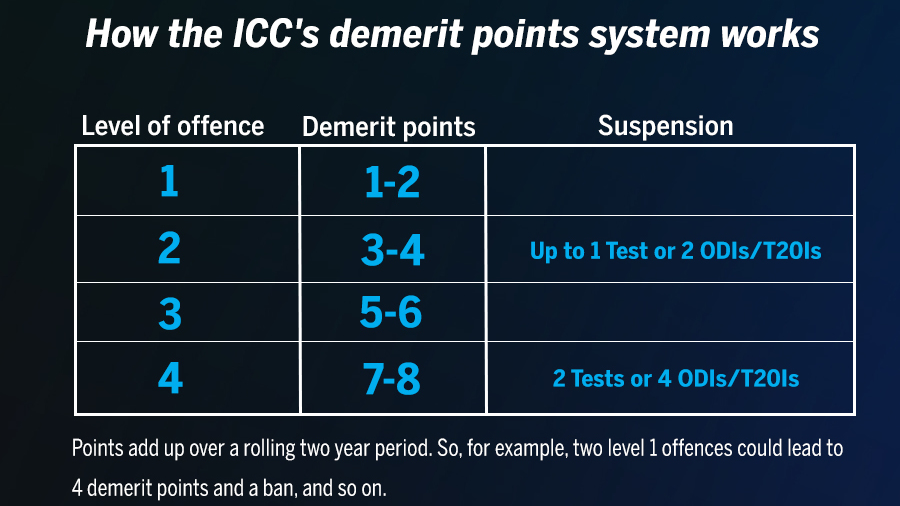
Number of demerit points according to the level of offence
So, as you guys can see, if you get 3 or more demerit points you will be suspended for one test or 2 limited over games. This depends on the next match his team is going to have. If it is an ODI match or a T20I match, then the suspension will be 2 limited over matches and so on.
Are these points valid for his whole cricketing career?
The demerit points are valid for 24 months from the day of the offence. So, if you commit an offence in November 2019, then you will have those demerit points in your total until November of 2021.
And so in simple terms, if you commit two level 1 offences inside two years, you will be banned for one test or two limited over matches
What are these levels of offences?
Well, all of these offences have been written down in the 42nd law in cricket. Let me simplify it for you.
Level 1 Offences
Jimmy Anderson was for showing discent at an umpire’s decision
showing serious dissent at an umpire’s decision by word or action
making inappropriate and deliberate physical contact with another player
throwing the ball at a player, umpire or another person in an inappropriate and dangerous manner
using language or gesture to another player, umpire, team official or spectator that, in the circumstances, is obscene or of a seriously insulting nature
anything else that umpire thinks is a level 2 offence
Level 3 Offences
intimidating an umpire by language or gesture
threatening to assault a player or any other person except an umpire
Level 4 Offences
threatening to assault an umpire
making inappropriate and deliberate physical contact with an umpire
physically assaulting a player or any other person
What is an example where demerit points were given?
So, in a test series between Sri Lanka and India, Indian player Ravindra Jadeja was banned to play a test match as he had collected more than 3 merit points. He had already collected 3 demerit points in an earlier series for stepping on the pitch. And in this series, he had thrown the ball at the batsman which umpires decided as dangerous. So, he was given another 3 demerit points. This made his total demerit points 6 resulting in a one test match ban.
Who decides the level of offence and the number of points that should be given?
So, it is a combination of on-field umpires and the match referee. The on-field umpires inform the match referee about the breach. He then decides the level of offence and the number of points that player deserve by considering the breach.
In my opinion, this is really good thinking from the ICC to not to give the responsibility to the on-field umpires to give the demerit points to the players as the emotional state of the umpire would have a larger impact on that decision.
When was this introduced to cricket?
This was introduced in September 2016 by ICC
Who has got the most number of demerit points inside 24 months so far?
There are only two players who have made it to the 6-point mark. As you know Ravindra Jadeja from India has got 6 points. Sri Lanka’s wicket-keeping batsman Niroshan Dickwella has collected 7 points inside 24 months.
Is this 24-month period unfair for the batsman?
The batsman can indeed be punished twice for the same offence. Well, I think this is the way it should be because the players are not supposed to breach the code of conduct repeatedly. And if they do so, they must get punished for it.
I hope you guys enjoyed my new article. I think I gave my best to write this article. Thank you for taking the time to read the article. See you tomorrow.
Today, I am going to talk about the backstory of Cricket. All of you guys may find it interesting to find out how cricket evolved over the years to get to where it is right now. Let’s get started.
Where and when was cricket invented?
Cricket is said to be invented in the south-east part of England in the 16th century. And actually, it became the national sport of England in the 18th century.
How Cricket got its name?
This is how Wikipedia describes it:
In the earliest definite reference,it was spelled creckett. The name may have been derived from the Middle Dutchkrick(-e), meaning a stick; or the Old Englishcricc or cryce meaning a crutch or staff, or the French word criquet meaning a wooden post.[3] The Middle Dutch word krickstoel means a long low stool used for kneeling in church; this resembled the long low wicket with two stumps used in early cricket.[7] According to Heiner Gillmeister, a European language expert of the University of Bonn, “cricket” derives from the Middle Dutch phrase for hockey, met de (krik ket)sen (i.e., “with the stick chase”).
It is believed that cricket was introduced to other countries via English colonies
How many balls per over?
Cricket initially started with 4 balls per over. Then it was replaced by five balls per over. Then they came to the current standard which is 6 balls per over. However, some countries like Australia have experimented with 8 ball overs. By the year 2000, a rule was created limiting the number of balls in an over to six.
What was the first international cricket game?
The first-ever international game was held between US and Canada in 1844.
What was the first overseas tour?
The England team went on a tour to North America in 1859 which is considered as the first-ever overseas tour.
How limited-overs matches were introduced?
It was in Melbourne in 1971 where a test match had been abandoned because of heavy rain. A limited over match was played between the two teams as the fans were so disappointed.
I hope you guys enjoyed reading the article. See you next time!
Today I am going to talk about underarm bowling in cricket and about how it all started.
What is underarm bowling?
This is how actually the bowlers bowled in cricket before the roundarm style was introduced. Bowling underarm is basically bowling with the hand below the waist. In fact, bowling was there even before cricket was introduced.
Is it legal to bowl underarm?
No. It is not legal now. But it was legal in the past
How did it become popular?
On 1st February 1981 in a match between New Zealand and Australia, New Zealand needed 6 runs for the last delivery to win the match. The series was in a tie and this was the third match. Aussie captain Greg Chappell instructed his brother Trevor Chappell who was the bowler to bowl the last delivery underarm to make sure that New Zealand batsman can not hit it for a six.
This indeed was legal at that time. But it was against the spirit of the cricket.
Watch this video on YouTube to see how Glenn Mcgrath “tried” to ball a ball underarm and how umpire Billy Bowden reacted to it in the video down below. 😂
Billy reacts funnily to Mcgrath’s attempt to bowl underarm
Ball-tampering is altering the condition of the ball so that the aerodynamics of the ball aids swing balling.
How does cricket laws state this?
Under Law 41, subsection 3 of the Laws of Cricket, the ball may be polished without the use of an artificial substance, may be dried with a towel if it is wet, and have mud removed from it under supervision; all other actions which alter the condition of the ball are illegal. These are usually taken to include rubbing the ball on the ground, scuffing with a fingernail or other sharp object, or tampering with the seam of the ball.
Players can use sweat or saliva to shine the ball to achieve more favourable bowling conditions.
Occasions where ball-tampering has happened?
Chris Pringle (1990) of New Zealand
Michael Atherton (1994) of England
Michael Atherton was the England captain and was accused of tampering with the ball. He denied the whole thing and said that he had some dirt in his pocket which he used to keep his hands warm. But he failed to disclose that “dirt” and hence was fined £2000.
Waqar Younis (2000) of Pakistan
Became the first player to receive a suspension because of ball-tampering.
Rahul Dravid (2004) of India
He was caught rubbing a cuff lozenge on the ball’s shiny side and was fined 50% of his match fee.
England Team (2005)
Marcus Trescothick admits in his autobiography that he used mints to shine the ball.
Pakistan Team (2006)
You guys must read this article on Wikipedia. This is one of the craziest stories about ball-tampering I’ve ever heard.
I think everyone knows about this incident. Cameron Bancroft of Australia was caught guilty for tampering with the ball with sandpaper. It was later revealed that the captain Steve Smith and the vice-captain David Warner were aware of all the things.
Steve Smith – 12 months
David Warner – 12 months
Cameron Bancroft – 9 months
The 3 players were charged with bringing the game into disrepute and were banned from all international and domestic cricket. The suspension periods are as following:
Even the Australian prime minister addressed the media and said that he was shocked to hear the news and he did never expect that kind of a thing from his players.
Sri Lanka vs West Indies (2018)
Sri Lankan former captain Dinesh Chandimal was given a one-match ban for having tampered with the ball.
I hope you guys learned something valuable today. Thank you for taking the time to read the article. See you soon ✌
In this article, I am going to talk about a thought that may have entered your mind someday.
Why LBWs are given out and the ball touching the bails is considered not out?
This is according to cricket’s 29th law.
29.1.1 The wicket is put down if a bail is completely removed from the top of the stumps, or a stump is struck out of the ground,
29.1.1.1 by the ball, 29.1.1.2 by the striker’s bat if held or by any part of the bat that he/she is holding, 29.1.1.3 for the purpose of this law only, by the striker’s bat not in hand, or by any part of the bat which has become detached, 29.1.1.4 by the striker’s person or by any part of his/her clothing or equipment becoming detached from his/her person, 29.1.1.5 by a fielder with his/her hand or arm, providing that the ball is held in the hand or hands so used, or in the hand of the arm so used. 29.1.1.6 The wicket is also put down if a fielder strikes or pulls a stump out of the ground as in 29.1.1.5.
29.1.2 The disturbance of a bail, whether temporary or not, shall not constitute its complete removal from the top of the stumps, but if a bail in falling lodges between two of the stumps this shall be regarded as complete removal.
So, in simple terms, at least one bail must be completely removed for the batsman to be out.
What if the batsman hits the wicket in his follow-through?
It is not out. This happened once recently in an ODI match between West Indies and Bangladesh. The batsman batting was Oshane Thomas. He played a shot and was on his follow-through when his bat hit the wicket and the lights lit and the bails fell off.
Oshane Thomas Hitting The Wicket, But was given not out
I hope you guys enjoyed the article. Thank you for taking the time to read it. If you have any doubts about cricket, drop a comment down below so I could talk about that in a future article. Stay safe ✌























































 The Coding Cricketer